/Logo%20no%20tagline%2c%20small.webp?width=100&height=37&name=Logo%20no%20tagline%2c%20small.webp)

/Logo%20no%20tagline%2c%20small.webp?width=100&height=38&name=Logo%20no%20tagline%2c%20small.webp)
Incentives for blood donation are already part of many donor recruitment conversations. Gift cards, coffee rewards, food offers, branded items, points, event tickets, raffles where allowed, and charity options can all be used as thank-yous that support donor participation.
But for blood centers, the real financial story is not only the face value of the incentive. A $10, $15, or $25 reward only does its job if the donor actually receives, claims, and uses it.
In this article, we'll explore incentives for blood donation from a practical program-management perspective. You’ll walk away knowing exactly what to ask your reward provider before your next donor campaign, to ensure you’re maximizing your budget and meeting your goals.
TL;DR
Blood donor incentives should feel like a thank-you, not a transaction.
- Claim rates show whether rewards actually reached donors, not just whether they were sent.
- Better reporting helps blood centers protect budget, improve donor experience, and plan stronger campaigns.
Blood donor incentives are already part of the conversation
Most blood, plasma, and platelet donation centers I’ve talked to over the years are not starting from zero on incentives. They already know that donor recruitment takes planning, timing, and community outreach. People usually need several reasons to take time out of their days and show up.
Incentives are an important part of that mix. Of course they’re not a replacement for altruism, donor education, staff relationships, or trust in the blood collection organization. But they are a really great way to say, "you helped us, and we appreciate you and we hope you come back."
And gift card incentives for blood donation have become a fixture in this space for a reason. Graf et al.’s 2024 BEST Collaborative Study, Blood Donor Incentives across 63 Countries, found that about half of the countries surveyed use some kind of financial-value incentive for donors, including formats like gift cards and raffles.
Local rules, culture, and donor expectations always matter. But the study makes one thing clear: flexible, practical thank-yous are already part of the global blood donor incentive landscape. For blood centers, the bigger opportunity is making sure those rewards are delivered, claimed, reported on, and managed responsibly.
In the 10+ years I’ve been working in the incentives industry, I’ve seen blood centres move well beyond the old "water bottle or T-shirt only" mindset. Swag, food, and local partnerships can still work. But many donor teams now use gift card incentive programs because donors often value practical, flexible rewards.
The right incentive always depends on the donor audience, donation type, campaign goal, and local rules.
That can mean a coffee gift card after a morning donation, a prepaid card like VisaⓇ or MastercardⓇ for rare blood types and plasma donors, or a digital reward you can list in a donor portal or points program.
Incentives should feel like a thank-you, not a transaction
Of course, there is a caveat. Blood and plasma donation is not a normal commercial exchange. Incentive programs should never make it feel like one.
That’s why gift-exchange framing matters: donors help the community, and the blood center thanks them.
Altruism is still central to blood donation, but that does not mean incentives are irrelevant. In Kasraian and Maghsudlu’s study, Blood donors’ attitudes towards incentives, many donors say they donate for altruistic reasons, but more than a quarter still believed incentives should be offered to encourage donation.
The more practical takeaway for blood centers is who was most open to incentives. Interest was higher among younger donors and first-time donors, and it decreased as age increased. That matters for donor recruitment because the people most open to a thoughtful thank-you may also be the people blood centers most want to bring back for a second donation.
So the goal is not to replace altruism with a gift card.
The goal is to reduce friction, support participation, and create a clear appreciation moment after someone has made the effort to donate.
To do that, you'll want to use incentives carefully: as a timely, appropriate thank-you that supports participation, encourages return visits, and fits the donor audience you are trying to reach.
The face value of a gift card is not the full budget story
It's worth knowing that some platforms keep 100% of unclaimed value by contract. That's not an oversight, but a defined part of their business model.

If you've never checked your provider's terms on this point, it's worth asking them directly: what happens to unclaimed funds after they expire, and where does that money go?
Blood centers often focus on how much to offer: will they give a $10 reward, a $15 reward, or maybe a higher amount during a short-term shortage or for a first-time donor promotion?
Those are fair questions. But they are not the whole budget conversation.
The question I always want blood centers to ask is: what was actually claimed?
If your gift card provider can tell you that you sent $50,000 in donor rewards, but they can’t (or won’t???) clearly show how many donors actually claimed their rewards, you don’t have the full picture:
You know what was issued.
You don’t know how much of the donor thank-you actually reached donors.
And that gap matters for finance, campaign planning, and donor experience.
If a reward is never claimed, the campaign may look fully funded on paper while part of the intended value sits unused.
The questions every blood center should ask after a campaign
Again, "what did we send?" should sit beside "what did donors claim?"
After each campaign, your reward provider or gift card platform should help you answer questions like:
- How many rewards were issued?
- How many were successfully delivered?
- How many were claimed?
- What was the claim rate by campaign?
- What value remains unclaimed?
- Were any rewards undelivered, bounced, or sent to the wrong address?
- Can unclaimed or undelivered rewards be followed up on, resent, expired, credited, or otherwise handled transparently?
- Can reporting be broken down by campaign, location, donor segment, or donation type?
This is about giving donor recruitment, finance, and leadership teams the information they need to make better decisions.
Unclaimed rewards create hidden costs for donor programs
Unclaimed rewards are those that you send to clients, but that the client never actually sees.
In industry speak, it’s called ‘breakage,’ and it ultimately leads to money left on the table, in the form of unused gift cards and prepaid cards.
And knowing what happens to that money can make the difference between a rewards program that quietly leaks value and one that protects your budget, keeps you compliant, and gives you a clearer picture of your true program costs.
Gift card rewards may go unclaimed for any number of ordinary reasons: a wrong email address, a spam filter, an unclear subject line, a long delay after donation, a reward mismatch, or a donor simply forgetting to claim it.
Remember too that some donors are purely motivated by altruism. So using that gift card you sent them might just not be top of mind.
None of these reasons for breakage are dramatic, and they don’t always have to be ‘fixed.’ Some amount of unclaimed rewards is normal.
But they matter because of the huge impact they can have on your incentive budget.
If a reward is recorded as spent, but the recipient never claims it, that value has to go somewhere. If your provider keeps the unused funds, your organization gets nothing back, and your recipient gets nothing either.
Meanwhile, if your provider doesn’t clearly show you what was claimed, what expired, and what remained unused, you’ll be left guessing. You won’t see if value is being lost, which reward types are underperforming, or how to improve the program over time.
Physical gift cards have a different visibility issue. Handing out a plastic card on site can work very well for certain drives and donor populations. A donor who wants a $10 coffee card after donating may be perfectly happy to receive it before leaving the event.
The tradeoff is that physical cards are harder to connect to claim behavior. If a donor loses the card or never uses it, the program administrator may never know what happened after distribution.
That is why unclaimed value should be treated as more than a finance metric. It is also a signal about the donor journey. For more background on the economics and program implications, Giftbit's guide to unclaimed gift cards is a useful next read.
Unclaimed value is also a donor experience issue
If you use incentives for your blood donors, you’re doing so for a reason, and likely with a goal in mind. That donor reward is part of the thank-you. When it reaches the donor quickly and clearly, it can reinforce your message: you showed up, you helped, and we followed through.
But if your thank you gifts don’t reach your donor, you lose that moment. And your team might even not know whether the issue was delivery, messaging, timing, reward choice, or follow-up.
I like to make sure the program administrators I work with understand just how much better reward reporting can help them move from guessing to improving. For example, if one campaign has a lower claim rate than another, you can look at timing, email wording, donor segment, brand choice, donation type, and location.
💡 Pro-tip: If you have insight into unclaimed or undelivered cards, take a few minutes to line up that list next to donors who haven’t come back. You may find a correlation between these two events.
Better reporting changes how blood centers manage incentives
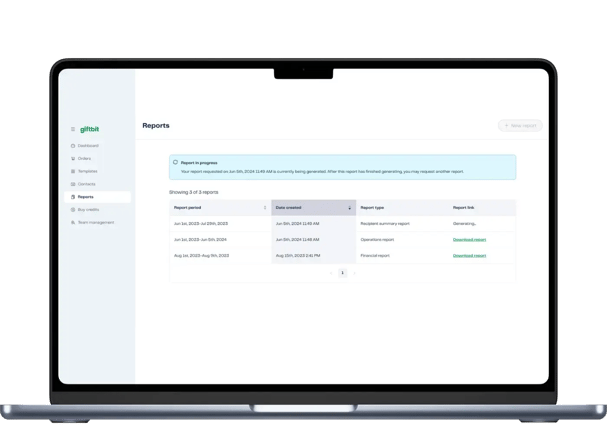
Donor incentive programs no longer have to be "send a gift card and move on."
Blood centers often operate across multiple offices, drives, teams, budgets, and donor workflows. So Donor Recruitment might need campaign performance. Finance might need unclaimed value visibility. And Leadership might simply need confidence that incentive spending supports recruitment and retention goals.
That is where reporting changes the conversation.
Remember that with the right gift card tracking and reporting, blood centers can see whether rewards were issued, delivered, and claimed. They can also compare claim rates by campaign and evaluate whether reward value, brand choice, timing, or recipient choice affected results.
This is also where gift card delivery and gift card distribution become operational issues, not just fulfillment tasks. Delivery, tracking, follow-up, and reporting all affect whether incentives are easy to manage at scale.
What blood centers should track
At minimum, donor incentive reporting should make it easy to track:
- Rewards issued
- Rewards delivered
- Rewards claimed
- Claim rate by campaign
- Unclaimed value
- Delivery failures or bounce issues
- Time to claim
- Reward type or brand performance
- Campaign, location, donor segment, or donation type
- Follow-up actions for unclaimed or undelivered rewards
Not every metric needs to become a dashboard project, and you’ll likely find that some matter more to your program than others.
But basic visibility should not be optional. You should be able to answer core operational questions without stitching together screenshots, manual exports, and guesswork. If a platform does not make this information easy to access, that creates extra work for your team and makes it harder to understand what is actually happening in your program.
Choosing rewards that donors will actually claim
A strong donor incentive program should ask two questions at the same time: what will motivate donors, and what will donors actually claim and use?
Gift cards can work well because they are familiar, practical, and easy to understand.
For example, Johns Hopkins Hub’s coverage of Mario Macis’s critical research found that rewards can increase blood donations in certain settings.
In one U.S. example, a $10 gift card was associated with a 50% increase in donations.
That doesn't mean every campaign should expect the same lift, but it does show that good incentive design can make a real difference.
Brand fit matters too. Coffee and quick-serve restaurant rewards can make sense around blood drives because donors may want something to eat or drink afterward. Meanwhile, broad retail options like Amazon and Walmart gift cards can work because they are so familiar and flexible.
But the more diverse the donor audience, the harder it is to pick one perfect brand. That is where recipient choice helps. A good rewards catalog will your donors choose from relevant gift cards, prepaid options, and in some cases charity options, instead of forcing every donor into the same brand.
Digital delivery also works especially well when donors already interact with email, a donor portal, a loyalty points store, or another post-donation workflow. For teams that need broader background, Giftbit's guide to bulk digital gift card rewards explains how digital reward programs can support faster fulfillment and better tracking.
And yes, physical cards can still have a place. On-site events, older donor populations, and certain local promotions may be better served by a card handed directly to the donor. The decision is a tradeoff between immediacy, donor preference, reporting visibility, and follow-up options.
Consider charitable choice and double altruism
Some donors may appreciate the option to direct reward value to charity.
Graf et al. discussed the idea of "double altruism," where the incentive can become another act of giving rather than a private benefit.
That doesn’t mean that charity should replace regular reward choices.
It means charity options should be available alongside gift card brands, so donors can choose whether they want to spend the reward themselves or pass that value on to a cause they care about.
What to ask your reward provider before the next donor campaign
Blood centers shouldn’t feel the need to replace an existing process just because another provider has a larger catalog or an upfront discount.
But I truly believe they should understand what happens after rewards are issued.
Before the next donor campaign, ask your current or prospective provider:
- Can I see claim rates by campaign?
- Can I see unclaimed value?
- Can I follow up on undelivered or unclaimed rewards? (these three are kind of redundant from the previous list)
- Can I export reports for finance or leadership?
- Can multiple locations or teams manage campaigns without losing visibility?
- Can donors choose from relevant brands or charity options?
- Can rewards be sent in bulk or through an API if our donor workflow requires it?
- What happens to unclaimed rewards, and is that clearly reported?
- How quickly is the average customer support query resolved? (Giftbit’s is under 10 minutes 💪)
These questions are especially important for larger blood centers, multi-location organizations, and teams that connect reward delivery to donor portals, points programs, or other systems.
Giftbit helps teams send gift cards in bulk, offer donor choice, track delivery and claim activity, manage unclaimed rewards more transparently, and support higher-volume or integrated workflows through the platform and API. The value doesn’t just come from the reward catalog (even though it’s big and growing!). It comes from seeing what happened next.
Incentives for blood donation work best when they are treated as a thoughtful donor appreciation program, not just a reward line item. If your team wants more visibility into claim rates, unclaimed value, donor choice, and campaign reporting, book time with Giftbit's Sales team to talk through a better way to manage incentives for blood donation. Or simply sign up for a free account and see how well it works on your next campaign.
Giftbit makes incentives for blood donation easy and cost-effective.
Create a free account to get started, or book some time wit if you've got question or would like to chat bulk discounts.
How to start using gift cards for blood donor incentives today
Check out the Giftbit Overview to learn how, or create a free account to see how easy it really is.