/Logo%20no%20tagline%2c%20small.webp?width=100&height=37&name=Logo%20no%20tagline%2c%20small.webp)

/Logo%20no%20tagline%2c%20small.webp?width=100&height=38&name=Logo%20no%20tagline%2c%20small.webp)
by Aaron Zide | Giftbit Senior Director, Business Development
Market researchers spend a lot of time thinking about how to turn insight into impact. They’re constantly assessing methodologies, refining KPIs, exploring new technologies, and looking for smarter ways to use increasingly tight budgets.
But how much insight do you have into your incentive program?
Many teams think of sending incentives as a one-and-done task: just send the reward, and the project moves forward. But just because a gift card was ‘sent,’ doesn’t mean you know what happened next.
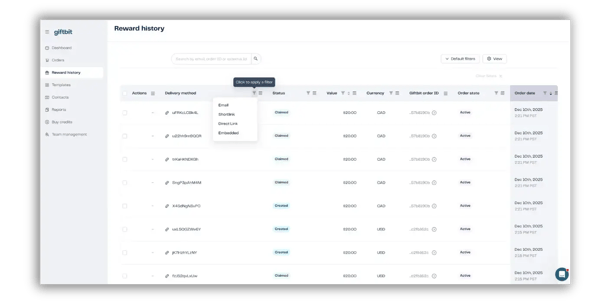
If your current gift card provider is working for you, great. Still, it’s worth asking: Can you see whether rewards were actually claimed? Do you know how much value is sitting unclaimed? And are you getting any of that money back?
TL;DR
If you can’t see whether incentives were claimed or what happens to unclaimed value, you’re missing useful data and potentially leaving money on the table.
Better incentive reporting can help research teams improve programs, recover budget, and make more informed decisions going forward.
Incentive delivery isn’t the same as visibility
Most research teams already know that some incentives go unclaimed. What they may not realize is how little visibility their provider gives them into that activity.
Knowing that an email was sent is not the same as knowing that a participant claimed their reward. Without claim-status reporting, teams are effectively operating with a blind spot in their programs.
That matters because incentives are not separate from research performance. Claim data can help you understand whether your incentive amount, delivery timing, or participant communications are working as intended. It can also surface unusual activity that deserves a closer look.
Market researchers expect evidence from every other part of their work—using data to support strategy is their modus operandi. They should expect that level of insight from their market research and survey incentives, too.
Unclaimed incentives are more than a sunk cost
Unclaimed rewards aren’t just an administrative detail. They represent both information and potential savings, too.
At Giftbit, we believe that our success comes from our customers’ success. That’s why we give research teams clear claim-status data and let them set expiration dates on rewards, all at no additional cost. When rewards expire unclaimed, Giftbit will return a portion of that value to your program—putting money back into the research budget instead of letting it disappear into incentive spend.
And I probably don’t have to tell you the financial impact that could have at scale. A team sending a high volume of incentives may have thousands of dollars tied up in rewards that participants never claim. Even recovering a portion of that value could lead to considerable cost savings. The key is having a provider that lets you see what is happening and gives you options for acting on it.
So if your current incentive provider can’t show what remains unclaimed, charges extra to set expiries, or keeps all the unused value, it may be time to ask why.
Better reporting creates better research programs
The financial benefit is only part of the opportunity.
Strong incentive reporting can help teams identify patterns across projects, audiences, reward values, and delivery timelines. If claim rates are unexpectedly low, perhaps the reward amount or participant communication needs to change. If every reward is claimed immediately—even in a program where that would be unusual—it may warrant further investigation.
These insights can improve future program decisions. They can also help research teams have more informed conversations with finance, procurement, and other stakeholders about how incentive budgets are being used.
Folks in market research often talk about breaking down silos between analytics, insights, and business strategy. I believe Incentive data belongs in that conversation. You can’t fully understand the performance of a research program if a meaningful part of its participant experience and budget remains invisible.
.webp?width=607&height=434&name=Graphic%20Reporting%20laptop%20(2).webp)
Reassessing your provider doesn’t have to mean a painful switch
Of course, reassessing your incentive provider doesn’t mean you have to switch overnight. Start by asking some straightforward questions:
- Can we see both delivery and claim status?
- Can we set appropriate expiration dates?
- What happens to the value of unclaimed rewards?
- Can any of that money be returned to us?
- Can we analyze performance across projects and reward amounts?
- Does the reporting help us make better decisions, or simply confirm that rewards were sent?
These should be easy questions for any gift card company to answer. If their answers are cagey or expose significant gaps, you might want to consider other options. And switching providers may also be a lot easier than you expect—even if your incentives are distributed through a gift card API.
Take MustardHub, which moved to Giftbit after finding its previous gift card API provider too rigid. Its development team had the new integration running within a couple of weeks without delaying its launch timeline. The company’s CTO describes the API as straightforward, reliable, and flexible enough to let the team build the experience it needed, without worrying about things breaking. Read the MustardHub case study.
And for market research firm Prime46, the technical work was even faster. Its developer connected Giftbit’s API to Sawtooth in just two days, automating a previously manual incentive process. That change now saves the project manager about 25% of his time each week, while also providing tracking, data, and reporting the team did not have before. Read the Prime46 case study.
Every integration is different. But changing providers doesn’t have to mean a months-long implementation or a major drain on development resources. A modern, well-documented API can make the business case for switching much easier to act on.
Apply the same curiosity to your incentive program
Market researchers are skilled at questioning assumptions, finding overlooked information, and using it to make better decisions. Your incentive program deserves the same scrutiny.
Before looking for the next complicated way to reduce research costs, take a closer look at the money and information already moving through your rewards program. You may find that one of the easiest opportunities to improve visibility, recover budget, and make smarter decisions has been sitting in front of you all along.
I’m going to be at the upcoming 2026 The Market Research Event, where I’m looking forward to chatting with research teams about how better incentive visibility can help make their budgets work harder.
If you’re attending, I hope you’ll connect with me to compare notes on what happens to your rewards after they’re sent.
Otherwise, feel free to book some time with me to chat market research incentives.
How to send market research incentives in 3 easy steps
Check out the Giftbit Overview to learn how, or create a free account to see how easy it really is.

Send
Pick your brands, schedule delivery, and you're done. Or connect Giftbit to survey platforms like Qualtrics, SurveyMonkey, Alchemer, or QuestionPro through Zapier to automatically send incentives when a response is completed.